
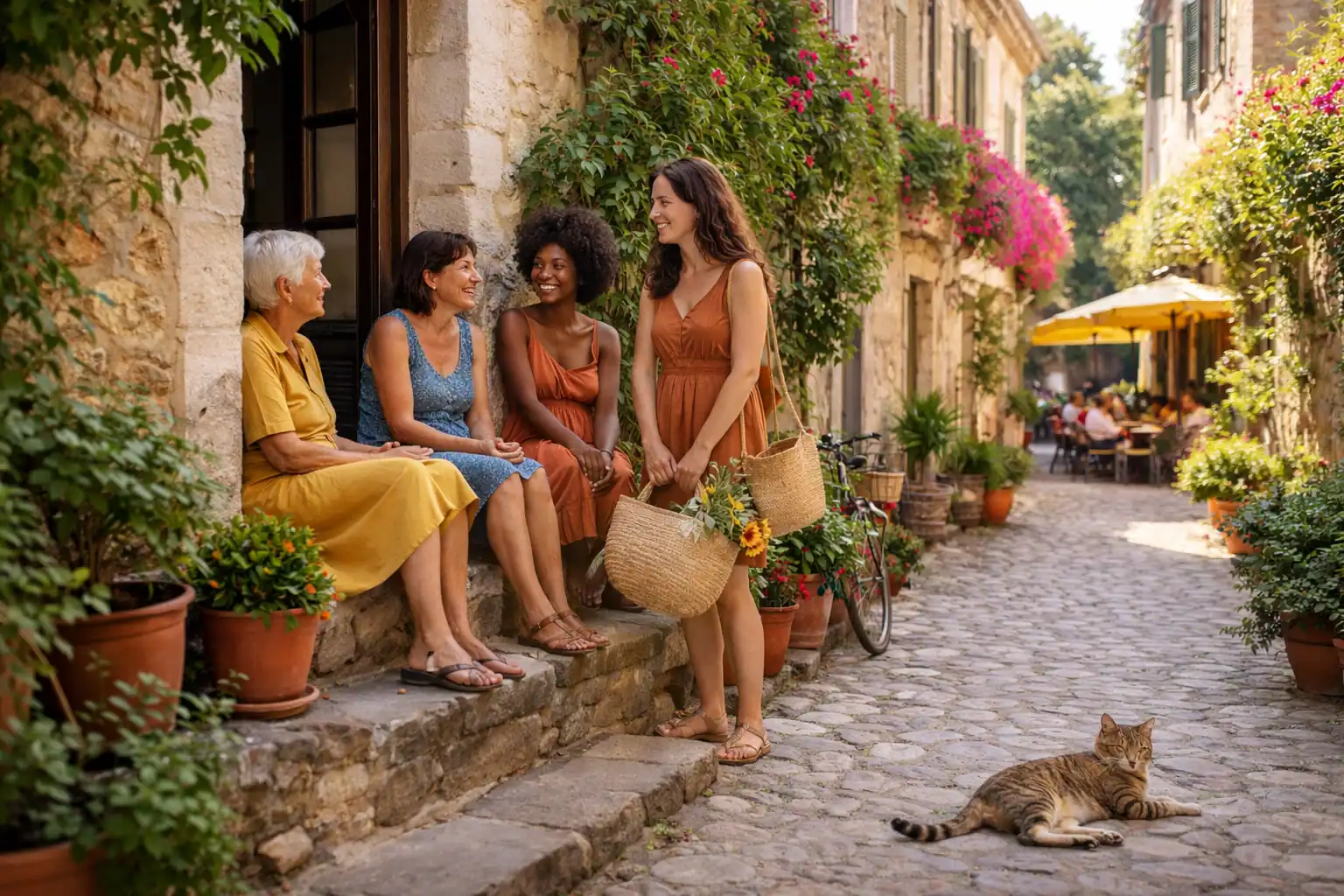
Most doorstep conversations do not begin because anyone has decided to be social.
Someone is watering a plant, carrying groceries inside, waiting for a relative, shaking a small rug or standing for one more minute before closing the door.
Another person passes.
There is a greeting, a question about the weather, a comment about a delivery or a small piece of news that does not need to become important.
Then both people continue with the day.
In some small Mediterranean towns, these brief exchanges remain visible because the edge between home and street is still used as a real place. A step can become a seat. A doorway can hold a conversation. A chair placed near the entrance can create enough pause for someone walking past to stop for two minutes.
This is not a universal Mediterranean custom, and it does not mean that every neighborhood is warm, open or socially close. Housing, work, privacy, age, tourism and local habits differ enormously.
The useful idea is narrower.
When people repeatedly see one another in a space that is neither completely private nor completely public, familiarity can grow before friendship does.
Quick answer: small connection usually begins with recognition
A doorstep conversation matters less because of what is said and more because the encounter can happen again.
The first exchange may be no more than a greeting.
The next time, one person remembers that the other was waiting for a repair, visiting family or taking a parcel to the post office.
After several encounters, neither person is entirely anonymous.
They may still know very little about each other. They may never enter one another’s homes or make plans together.
But they have become recognizable presences in the same daily landscape.
This is the beginning of neighborhood familiarity: not immediate intimacy, but the feeling that another person has a place in the surroundings you both use.
The doorstep is neither fully private nor fully public
A doorway marks a boundary, but it can also soften one.
Inside the home, conversation usually requires an invitation. In the street, approaching someone may feel more deliberate.
The doorstep sits between those two conditions.
A person standing there is still connected to the privacy of home, but is visible enough for a greeting to feel natural. The exchange can begin without either person making a formal social commitment.
This is what makes the threshold useful.
You can remain for a minute or return indoors. The person passing can stop or continue walking. Neither choice needs a long explanation.
The space allows contact without demanding closeness.
Repetition changes the meaning of a greeting
The same words can feel different when they are exchanged repeatedly.
A greeting from a stranger is polite.
A greeting from someone you recognize confirms that both of you remember the previous encounter.
Over time, the conversation may gather small details:
- whether the bus was late again;
- whether a shop has reopened;
- whether the weather will hold;
- whether a family member has arrived;
- whether the street will be closed;
- whether a plant survived the heat;
- whether the dog is finally calmer.
None of these details needs to become a deep confession.
The importance comes from continuity.
Someone listened before, remembered enough and noticed your return.
Familiarity is not the same as friendship
Not every valuable relationship needs to become close.
A neighbor may know your name, notice when you have been away and help you understand a local change without ever becoming someone you invite to dinner.
A shopkeeper may recognize your usual purchase without knowing anything about your private life.
A person sitting near the same doorway may greet you for years while the conversation remains brief.
These relationships can still make a place feel more legible.
You know who belongs to the ordinary rhythm of the street. You know whom you can ask about a delivery, a broken light or an unfamiliar car. You understand that your own presence has also become visible.
Our guide to neighborhood favorites in Mediterranean life explores a similar process through places rather than people: repetition gradually turns an ordinary corner, café or shop into something personally familiar.
Small talk is not failed serious conversation
Small talk is sometimes dismissed because it does not reveal much.
That may be precisely why it works.
A short exchange allows two people to acknowledge one another without crossing boundaries they have not agreed to cross.
The weather, the street, a local shop or something happening nearby creates neutral ground.
The conversation can remain there.
It does not need to become personal to have value. It has already established something simple: we have seen one another, and this place is shared.
Deeper conversation may arrive later, but it should not be treated as the measure of whether the first exchange mattered.
A short conversation needs an easy ending
Doorstep conversations work partly because they can end naturally.
Someone has food on the stove. A bag is becoming heavy. A child is waiting. Another errand still needs to be finished.
The physical situation already provides an exit.
This makes the encounter less demanding than a planned meeting.
No one needs to invent a reason to leave. The day itself provides one.
A useful casual connection respects that ending.
You do not keep someone standing with groceries because the conversation has finally become interesting. You do not interpret a short answer as rejection when the person may simply be tired or busy.
The ease of leaving is part of what makes it possible to stop again another day.
Architecture can create opportunities, not relationships
Some physical settings make repeated contact more likely.
Narrow streets, low steps, shallow front areas, chairs near entrances, visible balconies and routes used mainly on foot can place residents within sight of one another.
But design alone does not create trust.
A beautiful street can still feel socially closed. A modern apartment building can contain strong neighborly relationships. A village square can be welcoming to some people and uncomfortable for others.
The built environment creates the opportunity to notice.
What happens next depends on behavior, privacy, local norms and whether people feel safe enough to remain visible.
This distinction matters because it prevents us from turning old streets into a romantic explanation for every social relationship.
The doorway is different from the café table
A café is a public social setting. People choose to enter, sit and remain for a period of time.
A doorstep encounter is more incidental.
It happens while one person is still connected to home and another is moving through the street.
That difference changes the conversation.
At a café table, the encounter may have a clear duration and a shared activity. At a doorway, the exchange can remain unfinished without feeling interrupted.
Both spaces can support social familiarity, but they do so differently.
Our article about how Mediterranean cafés shape social life looks at the more public version of this connection, where sitting, observation and repeated visits create another kind of shared presence.
Not every open doorway is an invitation
Visibility should not be confused with availability.
An open door may be providing air. Someone standing outside may be waiting, working or trying to have a private telephone conversation.
A chair near the entrance does not automatically mean a visitor should approach.
Good informal contact depends on reading the response.
A returned greeting, relaxed posture or follow-up question may allow the conversation to continue.
A short answer, continued movement, closed body language or attention directed elsewhere usually means the exchange should remain brief.
Respecting those signals is not coldness.
It is what keeps casual contact from becoming intrusion.
Visitors should observe before participating
A traveler may notice doorstep conversations and imagine that the street is immediately open to everyone.
Usually, the visible ease is the result of repetition that the visitor has not shared.
The people speaking may have lived near each other for decades. They may understand local boundaries, family histories and subjects that should not be discussed in public.
A visitor can participate politely without treating the interaction as a cultural performance.
Greet people when a greeting is offered. Respond naturally to a simple question. Ask for practical information when it is genuinely needed. Do not photograph people at their doorway without permission or remain nearby merely to watch private life unfold.
The aim is not to collect an “authentic local moment.”
It is to behave appropriately in a street that remains someone else’s everyday environment.
Season and time of day change the threshold
The same doorway may behave differently throughout the year.
In warm weather, entrances may remain open longer and people may complete more household tasks near the street.
During colder, wetter or intensely hot periods, the same interaction may move indoors, to a café or disappear for part of the day.
Work schedules also matter.
A street that feels social in the early evening may feel empty during working hours. A retirement neighborhood may have a different daily rhythm from a street of holiday rentals. A busy resort in August may contain many visible people but very little repeated recognition.
The article is therefore not claiming that doorways automatically produce conversation.
They become socially meaningful only when people remain in the same place long enough to encounter one another repeatedly.
Tourism can increase visibility while reducing familiarity
A popular town may appear highly social because terraces are full, doors remain open and streets stay busy late into the night.
But movement is not the same as connection.
When the people passing change every few days, residents may experience the street less as a shared neighborhood and more as a route serving visitors.
Short-term accommodation can also change who is present at the threshold. Suitcases replace errands. Check-in instructions replace neighborly questions. The entrance becomes a point of arrival and departure rather than a place of repetition.
This does not mean tourism destroys every local relationship.
It means that a street can look more animated while offering fewer opportunities for people to become familiar to one another.
Small towns can make absence more noticeable
Recognition includes noticing when a familiar presence is missing.
A shutter remains closed longer than usual. A chair does not appear outside. Someone who normally crosses the street each morning has not been seen.
This does not always produce intervention, and it should not be romanticized as a perfect community safety system.
People can be isolated in small towns as easily as anywhere else. Neighbors may misunderstand one another, avoid one another or know that something is wrong without knowing how to help.
Still, repeated visibility can create a basic awareness that is harder to form when everyone enters through a private garage, elevator or anonymous corridor.
A familiar face can make asking a small question easier
Many everyday problems are too minor for a formal request but easier when someone nearby is familiar.
You may ask:
- whether rubbish collection has changed;
- where a package may have been left;
- whether the water is off in the whole street;
- when a local shop normally opens;
- whether a noise has been heard before;
- whether a repair vehicle has already arrived.
These questions do not require close friendship.
They require enough previous contact that speaking no longer feels like approaching a complete stranger.
Small practical exchanges can then strengthen familiarity further, because the relationship now contains a shared piece of local knowledge.
Doorstep conversation is not a cure for loneliness
A greeting can improve the tone of a day without resolving isolation.
Someone can be recognized by many people and still lack the deeper relationships, practical support or sense of belonging they need.
The distinction protects the article from making a comforting scene carry more responsibility than it can.
The World Health Organization’s overview of social connection looks at a much wider picture that includes relationships, community resources and the social infrastructure that helps people meet and participate.
A doorstep exchange belongs somewhere inside that larger picture.
It is a small point of contact, not a complete solution.
What disappears when every entrance becomes only a passage?
Many modern entrances are designed for speed.
You leave an apartment, enter a lift, cross a lobby and reach a car or pavement without remaining anywhere long enough for another person to approach naturally.
This arrangement can provide privacy, security and convenience. Those are real benefits.
It also means that contact must happen somewhere else.
Perhaps it moves to the mailboxes, the dog-walking route, the playground, the corner shop or the same morning bus.
The important element is not the traditional doorway itself.
It is the existence of a shared point where people encounter one another repeatedly without needing to organize a meeting.
Familiarity can grow in any repeated shared place
The same process may happen:
- beside an apartment entrance;
- near a row of mailboxes;
- at the same bakery each morning;
- while walking a dog;
- at a bus stop;
- outside a school gate;
- near a market stall;
- along a small harbor route.
What matters is not picturesque architecture.
It is repeated, low-pressure visibility.
This is one reason small harbor towns can make everyday social life easier to read. Daily routes often remain close together, making it easier to recognize the same faces around shops, boats, cafés and waterfront paths.
How to support casual connection without forcing it
You do not need to become highly sociable or begin conversations with everyone.
A realistic approach is smaller:
- return a greeting when one is offered;
- look up long enough to recognize familiar faces;
- remember one small detail from a previous exchange;
- ask practical questions rather than immediately personal ones;
- allow silence when the other person does not want to continue;
- avoid using headphones during every short shared transition;
- thank people for small pieces of help or information;
- let the conversation end without trying to make it significant.
The purpose is not to manufacture community through constant conversation.
It is to leave enough openness for recognition to develop where it naturally can.
What a healthy doorstep exchange feels like
A good casual conversation leaves both people free.
Neither person feels trapped, questioned or required to perform friendliness.
The exchange may contain humor, information, concern or nothing more than acknowledgement.
It ends before either person needs to struggle for an exit.
Most importantly, it leaves the next encounter possible.
You can meet again without embarrassment, obligation or the feeling that the relationship now requires more than either person intended.
The value is often visible only after time has passed
One greeting rarely changes how a place feels.
Twenty greetings might.
You begin to know who opens the bakery, who leaves early for work, who sits outside after dinner and who walks slowly through the same part of the street each afternoon.
The neighborhood gains a human map.
It is not a map of friendships or private histories.
It is a map of recognition.
That map can make an unfamiliar town feel understandable and a familiar town feel less anonymous.
Final thoughts
Doorstep conversations in small towns are rarely dramatic enough to become stories.
Most end before anything memorable has been said.
But their value does not depend on memorable words.
It comes from the repeated permission to acknowledge another person without demanding access to their private life.
A threshold creates the opportunity. Repetition creates recognition. Respect allows the encounter to remain comfortable.
Sometimes the conversation grows.
Sometimes it stays at the level of weather, errands and a familiar greeting.
Both outcomes can belong to a healthy neighborhood.
Not every familiar face needs to become a close friend.
Sometimes it is enough to know that when you appear again, someone will recognize that you have returned.