
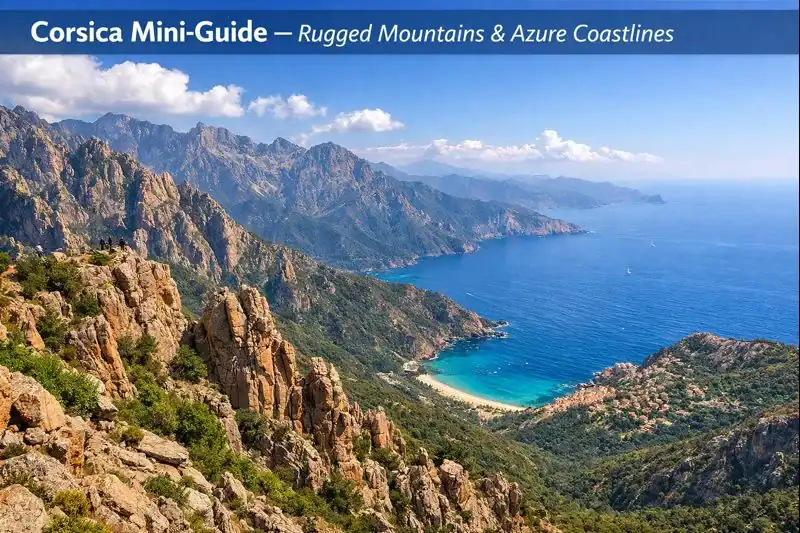
Corsica feels different from the moment you arrive. It is wilder, rougher, and less polished than many Mediterranean islands, with mountains that rise sharply from the center and coastlines that shift from bright turquoise coves to open, wind-shaped cliffs.
This is not the island for travelers who want every day to feel perfectly arranged. Corsica is better when you leave room for winding roads, long views, quiet villages, slow meals, and sudden stops by the sea.
Mountains That Shape the Island
Corsica is deeply mountainous, and that changes the whole feeling of the island.
The interior is not just background scenery. It gives Corsica its weight, its pace, and its sense of distance. Roads climb through forests, pass stone villages, and open suddenly onto valleys where the sea feels far away even though the island is not large.
Around Corte and the Restonica Valley, the landscape becomes cooler and more rugged. Granite peaks, river pools, pine trees, and mountain paths make the island feel less like a beach destination and more like a place built from contrasts.
Even if you do not plan a serious hike, the mountains still shape the trip. A short drive inland can change the light, the air, and the mood of the day.
Azure Coastlines and Wild Beaches
Corsica’s coast is bright, clear, and often surprisingly wild.
Some beaches feel soft and open, with pale sand and shallow turquoise water. Others are hidden below cliffs or reached after a drive, a walk, or a road that makes you slow down before you arrive. Places like Palombaggia, Rondinara, and Saleccia are known for their color, but the real charm is the feeling of space around them.
The coast rarely feels the same from one side of the island to another. In the south, the water can look almost tropical. On the west coast, cliffs and bays feel more dramatic. In the north, small harbors, rocky shores, and quieter corners give the island a more local rhythm.
Corsica is beautiful, but not always easy. That is part of its appeal.
Villages, Food and Local Character
Corsican villages often sit above the coast or deep in the hills, built from stone and shaped by the land around them.
They do not always try to impress quickly. A village may feel quiet at first: a church square, a shaded wall, a small café, a view across olive trees or chestnut forests. But that slower pace is exactly what makes Corsica memorable.
Food also carries this mix of mountain and sea. Expect cheese, cured meats, chestnuts, herbs, vegetables, seafood, local wine, and simple meals that feel connected to place. Corsican cooking does not feel only coastal or only French or only Italian. It has its own island character.
This is where Corsica becomes more than a pretty destination. The island has texture: rough roads, warm bread, mountain air, salt water, village shade, and meals that make more sense when you stop rushing.
When Corsica Feels Best
Corsica can be intense in high summer, especially around the most famous beaches and coastal towns.
If you want a softer version of the island, late spring and early autumn can feel more balanced. The weather is still warm enough for coastal days, but the roads, villages, and walking paths often feel easier to enjoy.
Winter is quieter and more local, though not every beach or village has the same energy out of season. If you are thinking about Mediterranean islands outside the main summer months, Mediterranean Islands in Winter is a useful next read for comparing the wider seasonal mood.
Corsica rewards travelers who understand that the island is not only about beach weather. It is also about movement: coast to mountain, village to harbor, road to viewpoint, morning walk to long lunch.
How to Approach a First Trip
A first trip to Corsica is easier if you do not try to see everything.
Choose one or two bases instead of crossing the island every day. Give yourself time for the roads. Let one beach, one village, or one mountain drive become the center of the day instead of trying to collect too many stops.
If you stay near the coast, plan at least one inland drive. If you stay inland, leave space for a slow coastal day. The island makes more sense when you feel both sides: the high, rugged interior and the bright edge of the sea.
For current planning, ferry routes, regions, activities, and practical travel details, official Corsica tourism resources are the best place to check before you decide where to stay.
Why Corsica Belongs on Your Mediterranean List
Corsica belongs on a Mediterranean travel list because it does not feel interchangeable.
It has beaches, but it is not only a beach island. It has villages, but they do not feel staged. It has mountains, but they are not separate from the coastal experience. Everything sits close together, yet the island still feels spacious and untamed.
Corsica is best explored slowly: by car, on foot, by stopping often, and by accepting that the most memorable part of the day may not be the famous view. It may be a quiet road, a shaded village, a simple meal, or the moment when the mountains suddenly drop toward the sea.
Corsica is not polished or predictable. That is exactly why it stays with you.