
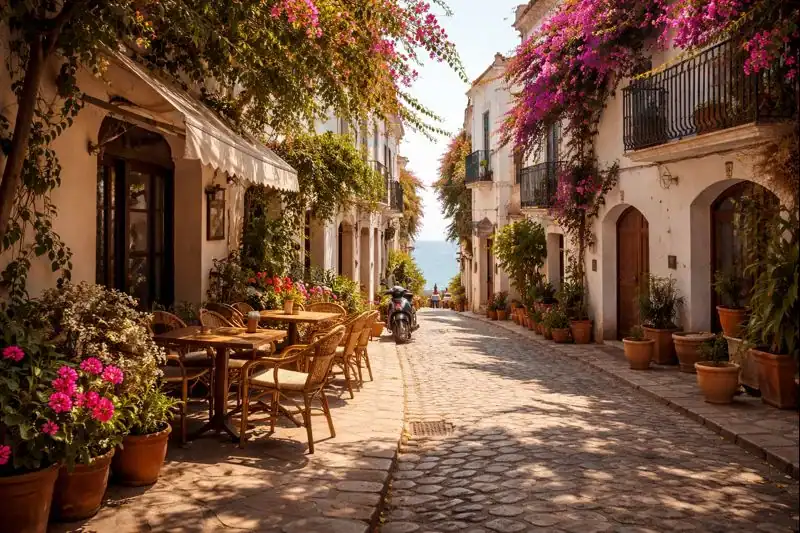
There’s a moment after lunch—somewhere between the last sip of espresso and the first hint of late-afternoon light—when Mediterranean cities feel like they exhale. Doors close softly. Chairs stop scraping. The street that was busy an hour ago suddenly belongs to shadows, flowerpots, and the distant sound of plates being cleared inside.
You don’t always notice it on your first day. Visitors are trained to keep moving. But once you catch it, you start to recognize the pattern: the gentler pace, the quieter corners, the way the city briefly becomes private again.
Quiet hours after lunch — Mediterranean cities
In many places around the Mediterranean, the early afternoon can be the calmest part of the day. Not everywhere follows the same routine, and not every neighborhood empties out—but a similar softness often appears: fewer errands, fewer conversations in the open, and a subtle pause before the evening returns people to the streets.
It’s not a “tourist attraction.” It’s closer to a local reset. The day splits in two: the practical part, and the social part. This middle stretch is the seam.
What it feels like (and why it’s worth noticing)
Quiet hours after lunch aren’t dramatic. They’re small. They look like:
- a bakery window that’s suddenly dark, even though it’s not late
- a narrow lane where your footsteps are the loudest sound
- cafés that stay open, but switch to a lower volume—more shade than chatter
- a plaza that feels briefly oversized, as if it was built for a crowd that will return later
If you’re the kind of traveler who loves texture—the everyday mood of a place—this is gold. The city becomes easier to read when it isn’t performing.
How to enjoy it without “wasting time”
The trick is to match the city’s pace instead of trying to fight it.
1) Choose a single, low-stakes route
Pick one short walk: from your lunch spot to a viewpoint, from the market to the waterfront, from a busy street to a residential lane. Keep it simple. The quiet is the point—arriving is optional.
2) Follow shade like it’s a map
In early afternoon, the most comfortable streets often aren’t the most famous ones. Look for:
- arcades and covered passages
- lanes with tall buildings (natural shade)
- parks with dense tree cover
- waterfront promenades with a breeze
3) Make the “closed” signs work for you
When shops shut their doors, it’s permission to stop browsing and start observing. Sit somewhere with a view—steps near a church, a bench facing a small square, a café table at the edge of a lane—and let the city pass quietly in front of you.
4) Save your biggest checklist for later
If you’re planning museums, shopping, or long attractions, place them in the morning or late afternoon. Early afternoon is better for:
- photo walks (softer, emptier streets)
- journaling or reading outside
- a slow coffee in shade
- a short climb to a lookout
A tiny ritual to try once
Do this one day: after lunch, buy one small thing—an orange, a bottle of water, a pastry for later—and walk ten minutes away from the busiest street. Then stop. Stand still for 30 seconds. Notice what you hear.
Often it’s not silence. It’s a different layer: shutters, pigeons, a mop bucket somewhere, the faint knock of cutlery behind a window. That’s the city being itself.
Where this “soft pause” shows up most clearly
You’ll find it in many Mediterranean places, but it tends to feel strongest in:
- old towns with tight streets and thick stone
- residential neighborhoods just beyond the center
- small coastal towns where the day is shaped by heat and light
- hillside cities where people retreat indoors until later
If you liked the feeling of wandering in calmer streets, you’ll probably also enjoy this related experience: Old Town Evenings — How to Find the Best Streets Without Crowds.
The city always comes back
What makes these hours special is that they’re temporary. By late afternoon, chairs return outside, streets refill, and the evening energy arrives like a second sunrise.
But for a little while, you get a softer version of the place—less crowded, less curated, more local. It’s the perfect time to slow your steps and let the city’s rhythm lead.
If you’re curious about the cultural backdrop behind this mid-day pause, this overview of the siesta tradition is a helpful starting point: Siesta (Britannica).