
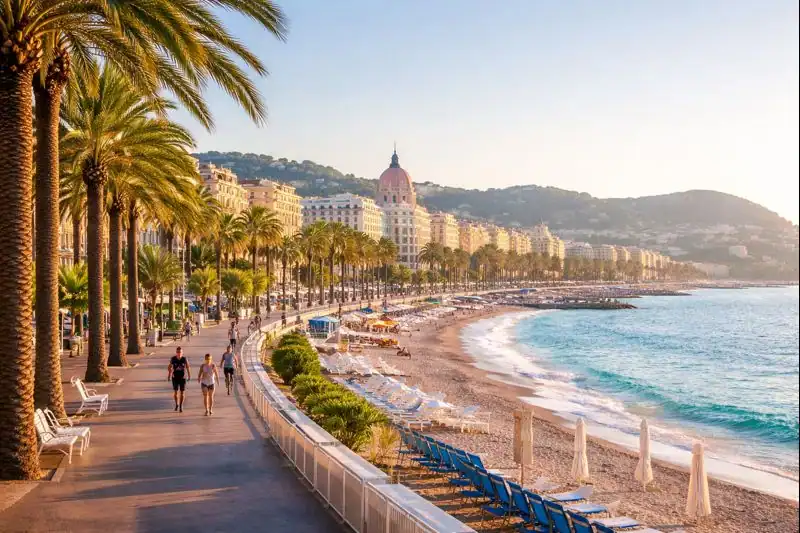
At 8 AM, Nice feels momentarily unclaimed. The beach is still quiet, umbrellas folded, chairs stacked in neat lines, and the Mediterranean stretches out calm and uninterrupted. This is Nice before the beach — the hour when the city belongs almost entirely to itself.

Nice before the beach
Along the Promenade des Anglais, movement is gentle and unhurried. A few runners pass, cyclists glide by without weaving, and locals pause briefly at the railing, looking out over the water as if checking the day before stepping into it. The light is soft and low, warming the façades and catching the tops of palm trees rather than the ground below.
In the Old Town, shutters lift one by one. You hear metal rolling upward, café cups being set onto tables, and the first delivery scooters passing quickly through narrow streets. Bakeries are already active, but nothing feels rushed. This is not the city performing for visitors — it’s simply starting its morning.
Down by the shore, the pebbles are cool underfoot. The sea moves steadily, without swimmers or paddleboards breaking its surface. For a short while, the beach feels less like an attraction and more like a shared edge between the city and the water.
If you’ve noticed similar early calm in other Mediterranean cities — like the waterfront hours described in Trieste in 24 Hours — Coffee Culture and Waterfront Breeze — the feeling will be familiar. Across the region, mornings often reveal a quieter rhythm that disappears later in the day.
For a broader sense of how these early hours fit into local life, the official Nice Tourism overview offers useful context about the city’s neighborhoods and daily flow.
By mid-morning, beach towels appear, cafés fill, and the promenade shifts toward its daytime role. But at 8 AM, Nice offers something brief and understated — a version of the city shaped by routine, light, and ordinary movement, before the beach takes over.
Leave a Reply