
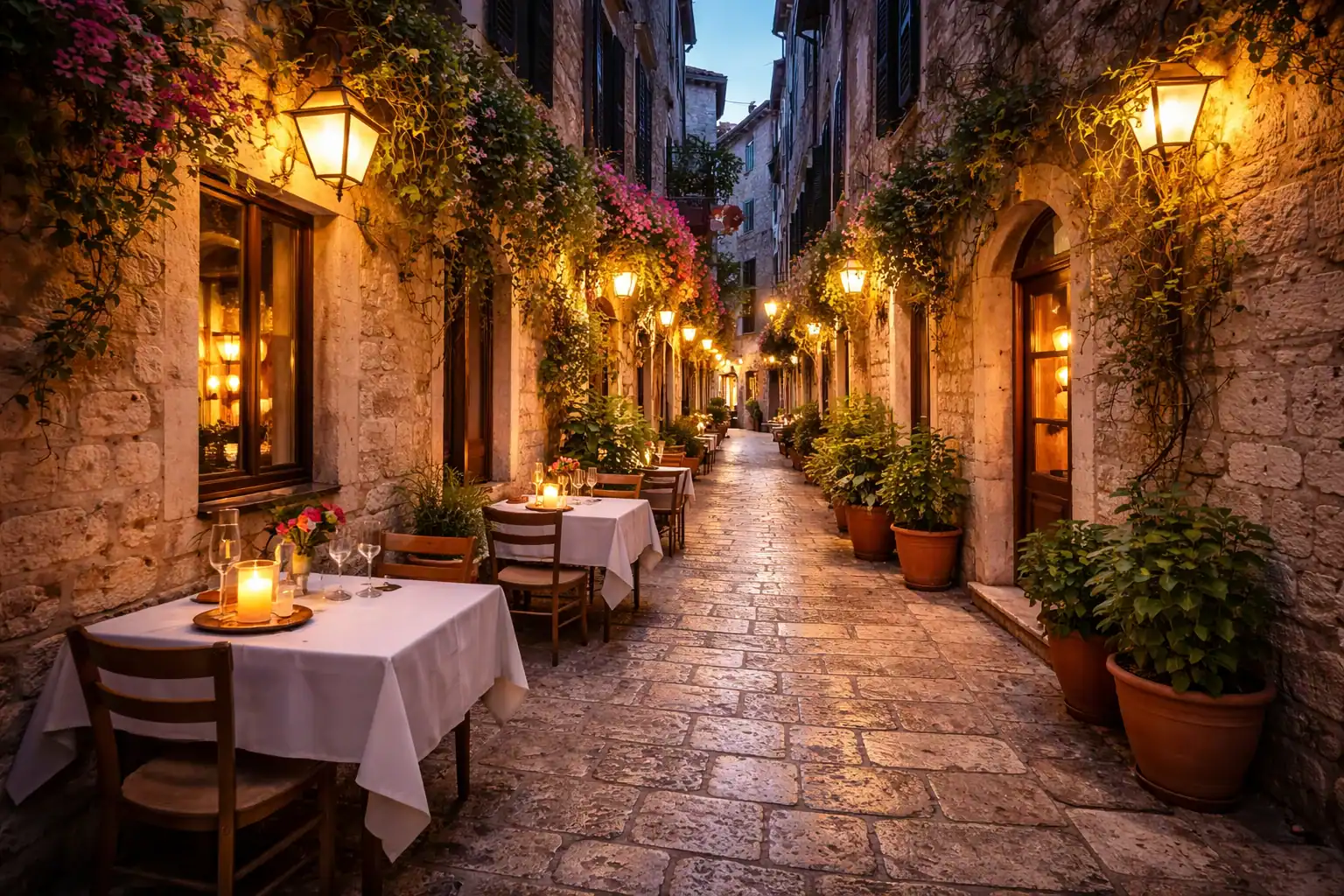
Split feels busiest when the sun is still high and the stone streets hold the day’s heat. By early evening, something begins to shift. The pace loosens, voices soften, and the old city starts to feel less like a destination and more like a place people actually live in.
Old town evenings in Split
Old town evenings in Split unfold in small, easy moments. The cafés along the main routes begin to clear, chairs scrape softly against stone, and the inner lanes take on a gentler rhythm. Light spills from doorways, and the narrow passages that felt crowded hours earlier become spaces for slow walking and quiet observation.
Just beyond the busiest squares, the city opens into pockets of calm. Small side streets curve away from the main flow, where shop shutters come down early and only a few tables remain set outside. The soundscape changes too — footsteps echo lightly, conversation drifts from open windows above, and the evening air carries a faint mix of warm stone and sea.
Wandering here doesn’t feel like sightseeing. It feels closer to being allowed into a private rhythm. You notice the uneven texture of the pavement, the way lantern light softens the edges of old walls, the brief stillness between passing footsteps. Even familiar routes feel different once the crowds thin and the city returns to itself.
There’s a quiet contrast between the waterfront energy and the inner lanes of the old town. A short walk away from the Riva, the glow of evening becomes more intimate, and Split’s historic center reveals a softer side — one shaped less by movement and more by presence. This rhythm mirrors what many historic Mediterranean centers share after sunset, when daily life gently replaces daytime tourism, a pattern you can explore more broadly in this reflection on old town evenings across the Mediterranean.
Sometimes, the quiet reveals itself in small, ordinary scenes: a local locking a shop door, a cat stretching across warm stone, a single table being cleared for the night. These moments don’t ask for attention, but they linger. They remind you that the old town is not only a backdrop for visitors, but a living place that continues after the cameras turn away.
To understand the deep history behind these streets, it helps to know that much of Split’s old town grew within and around Diocletian’s Palace, a living structure that still shapes how the city breathes today.
Old town evenings in Split are not about checking places off a list. They’re about letting the city slow you down — and noticing how quiet can feel like a welcome, not an absence.
Leave a Reply