
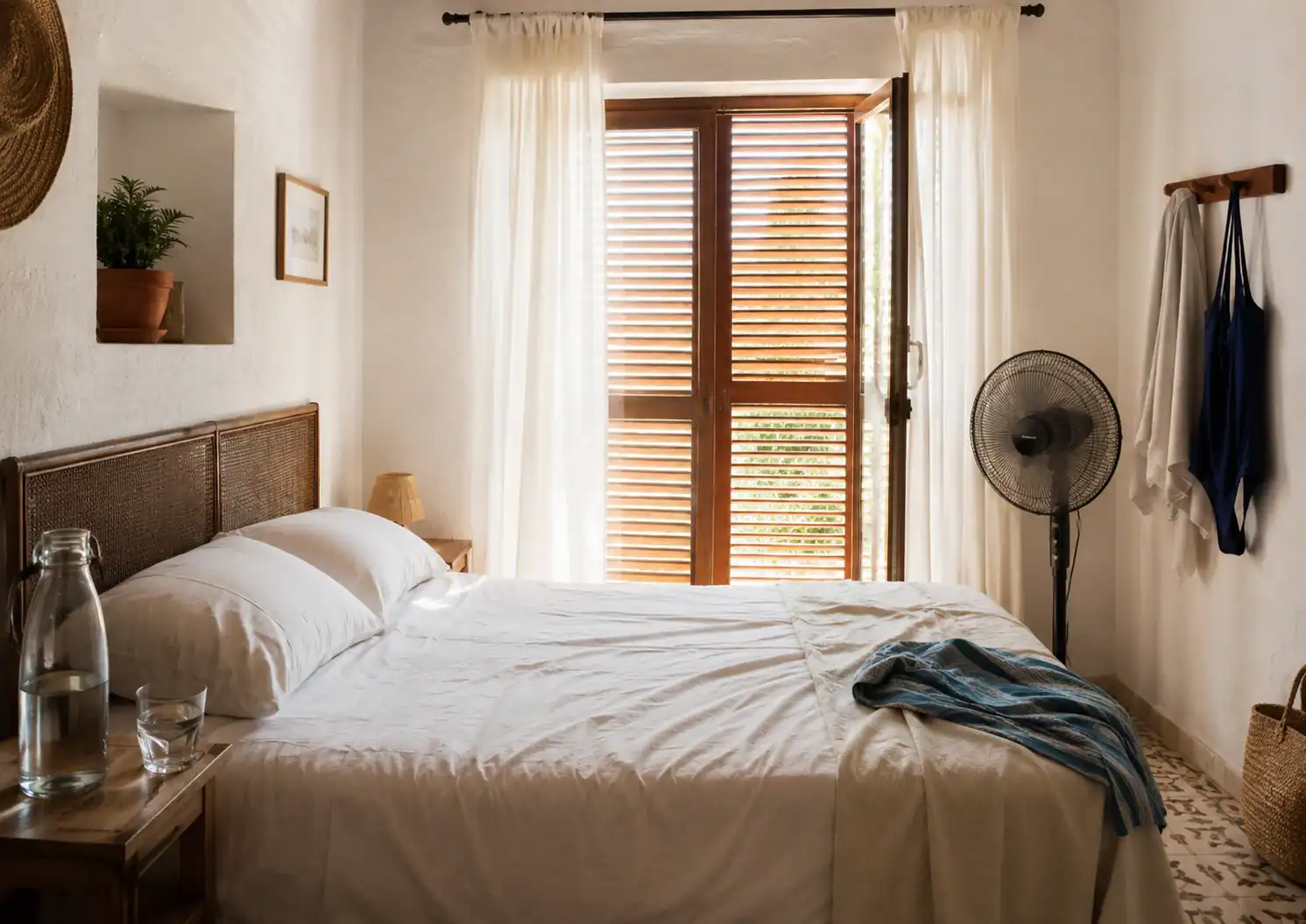
A Mediterranean summer apartment can look like a good deal when the price is lower, the beach is close and the photos show clean white walls. But the real test often comes much later, when the day is over, the room still holds heat, the air does not move, and the bed does not feel like rest.
A lower price can be a fair compromise. Many simple apartments are good enough if you understand what you are accepting. The problem starts when the saving comes from the wrong place: a bedroom that traps heat, a room without real airflow, towels that never dry, or a night that feels sticky instead of restful.
I once stayed in a cheap room that looked acceptable at first. The problem was not only heat. It was humidity. The sheets stuck to the body, swimsuits and towels did not dry overnight, and the room never felt fresh. The apartment cost less, but it took away the feeling of holiday. After a few nights like that, the saving did not feel like a saving anymore.
Price matters, but sleep is part of the price
When choosing a summer apartment, it is easy to compare location, photos, reviews and price. Sleep often comes last, even though it can shape the whole stay.
A room does not need to feel like a hotel with strong air conditioning. A simple fan, shutters, a window that opens properly and a clean, dry bed can be enough. But if the room is too humid, too still, too noisy or too exposed to afternoon sun, small fixes may only help a little.
That is why a summer rental should not be judged only by how close it is to the beach. It should also be judged by how the bedroom will behave at night.
Look carefully at the listing photos. Is the bed near a window, or pushed into a closed corner? Are there shutters or only thin curtains? Is there a fan? Are there mosquito screens? Does the room sit under a roof, on a top floor, or facing a narrow street that keeps heat after sunset?
These details do not always look important in photos. In July or August, they can matter more than a decorative balcony.
Check the bedroom before the view
A beautiful view is nice in the morning. At night, the room itself matters more.
A bedroom with a sea view can still be uncomfortable if the sun hits it for hours in the afternoon. A small back room can sleep better if it stays shaded and has a window that can be opened safely. An older apartment with thick walls can feel easier than a newer room with glass and no shade.
Before booking, look for clues. If the listing mentions air conditioning, check whether it is in the bedroom or only in the living room. If there is no air conditioning, look for a fan, shutters, blinds, mosquito screens and more than one possible opening. A window that opens only a little may not help much on a still night.
Reviews can also tell the truth. Search inside reviews for words like “hot,” “air,” “fan,” “mosquitoes,” “noise,” “humid,” “sleep,” and “shutters.” One small complaint may not matter. Repeated complaints about heat at night usually matter.
For a wider first-check approach after arrival, Mediterranean rental apartment tips are useful because the first hour often shows how the place really works, not only how it looked online.
Do not wait until midnight to fix the room
The biggest mistake is trying to save the bedroom only when you are already tired.
In a warm Mediterranean apartment, the night is prepared earlier. In the morning, open the room if the air outside is still fresh. Let the stale air leave before the sun becomes strong. Then close what needs to be closed: shutters, blinds, heavy curtains or anything that keeps direct heat out.
During the strongest sun, it is usually better to keep the room protected. It can feel strange to close a bright room in a beautiful place, but that is how many Mediterranean homes stay usable. Shade is not only decoration. It is part of the comfort system.
This is where Mediterranean window shutters matter. They are not just charming from the street. They decide how much sun reaches the room before bedtime.
Open again later, when the outdoor air is cooler. Evening air helps more than midday air. If the apartment has windows on different sides, a short cross-breeze can refresh the room faster. If it has only one opening, the improvement may be slower, but it is still better to work with the cooler hours than to fight the room after it has trapped heat all day.
Mosquito screens change the night
Opening a window sounds simple until insects arrive.
This is one reason mosquito screens are not a small detail in a summer apartment. Without them, you may have to choose between air and bites. With them, you can leave a window open longer, especially in the evening or early morning, without turning the room into a problem.
If the listing photos show screens, that is a good sign. If they do not, look at reviews. Guests often mention mosquitoes when they become a real issue.
If there are no screens, do not assume you can simply sleep with the window open. A room may be cooler with the window open, but less restful if you are waking up because of insects, street noise or light from outside.
For this reason, mosquito screens in Mediterranean homes are more practical than they may look. They can decide whether evening air is useful or only another compromise.
A fan can help, but do not use it too late
A fan does not make a hot room cold. It moves air. That can still make a big difference.
The best use of a fan is not always full speed for ten minutes before bed. On a difficult night, a low, steady setting can be more useful. It keeps the air from feeling completely still, and the soft, monotonous sound often becomes less noticeable once you fall asleep.
If the fan is too loud, move it farther away and lower the speed. If it blows directly on your face or neck, adjust it toward the room instead of the bed. The goal is not to feel wind all night. The goal is to stop the air from sitting heavy in one place.
A fan works better when the room has been protected during the day and aired at the right time. If the walls, floor and bedding are already holding heat and humidity, the fan can help, but it will not fully solve the problem.
For the broader air movement side of this, fans, open windows and cross-breeze in Mediterranean apartments explain how small rooms can change when air has a real path.
Humidity can be worse than heat
Heat is one problem. Humidity is another.
A warm room can still feel acceptable if the sheets are dry, the air is moving and the towels are not damp. A humid room feels heavier. Clothes dry slowly. Swimsuits stay wet. Towels smell tired. The bed feels wrong before you even get in.
This is why it helps to check where towels will dry before you settle in. Is there a balcony rail, a drying rack, a sunny window, or only a dark bathroom corner? Does the bathroom have ventilation? Does the room smell fresh when you arrive, or does it feel closed and damp?
A cheaper apartment can still be fine if it is dry and shaded. A more expensive one can still disappoint if everything stays damp. The feeling of holiday disappears quickly when the room never resets overnight.
This also connects with small practical details like laundry, towels and drying space. In hot places, water is everywhere: beach towels, swimsuits, showers, drinking water, wet hair, bathroom steam. A room that cannot dry things properly becomes uncomfortable fast.
The evening routine should stay simple
Small habits can help, but they should stay realistic.
A lukewarm shower before bed can make you feel cleaner and less sticky, especially after a long beach day or a hot walk back to the apartment. It does not need to be cold if you do not enjoy cold water. The point is to go to bed feeling fresh, not overheated and covered in salt, sweat or sunscreen.
Use lighter sleepwear if you need it. Keep water nearby. Avoid leaving wet towels on chairs, beds or closed bathroom hooks if there is any better place to hang them. If the room has a fan, test the lowest setting before you are too tired. If the shutters are difficult, learn them before dark.
None of this makes a bad room perfect. It only reduces the discomfort.
That is an important difference. A good apartment gives you small tools that work together: shade, air, screens, a fan, a place to dry things, and a bedroom that does not trap the day completely. A bad apartment leaves you using tricks against a room that was never suitable for summer sleeping.
Ask better questions before booking
Before choosing a Mediterranean summer apartment, it helps to ask a few practical questions, even if they sound less exciting than the view.
Is there air conditioning in the bedroom, not only in the living room?
If there is no air conditioning, is there a fan?
Are there shutters, blackout curtains or proper blinds?
Can the bedroom window open safely at night?
Are there mosquito screens?
Is the bedroom on the top floor or under the roof?
Does the room face strong afternoon sun?
Is there a drying rack for towels and swimsuits?
Do reviews mention heat, humidity, mosquitoes or noise?
A host may not answer every question perfectly, but even the way the listing is written can tell you something. A rental that explains shade, fans, screens and cooling honestly is usually more trustworthy than one that only shows pretty corners.
A good summer apartment does not need to be perfect
The right apartment does not have to be luxurious. It does not even have to be cold.
It should let you recover at night.
That means the bedroom should not feel like the worst part of the day. It should not make towels stay wet, sheets stick to your skin, or every night feel like a negotiation between heat, insects and noise.
A Mediterranean summer stay can handle small discomforts. A little warmth, a slower fan, shutters pulled during the day, a window opened at the right hour — these are normal parts of summer living. But when the room stops you from resting, the whole trip changes.
So the best apartment is not always the cheapest one, the brightest one or the one closest to the beach. Sometimes it is the one with the plain bedroom, working shutters, a fan that can run quietly through the night, insect screens on the window, and enough dry air to make the bed feel like a place to rest.
That is not a small detail. In summer, it can be the difference between having a place to stay and having a holiday.