
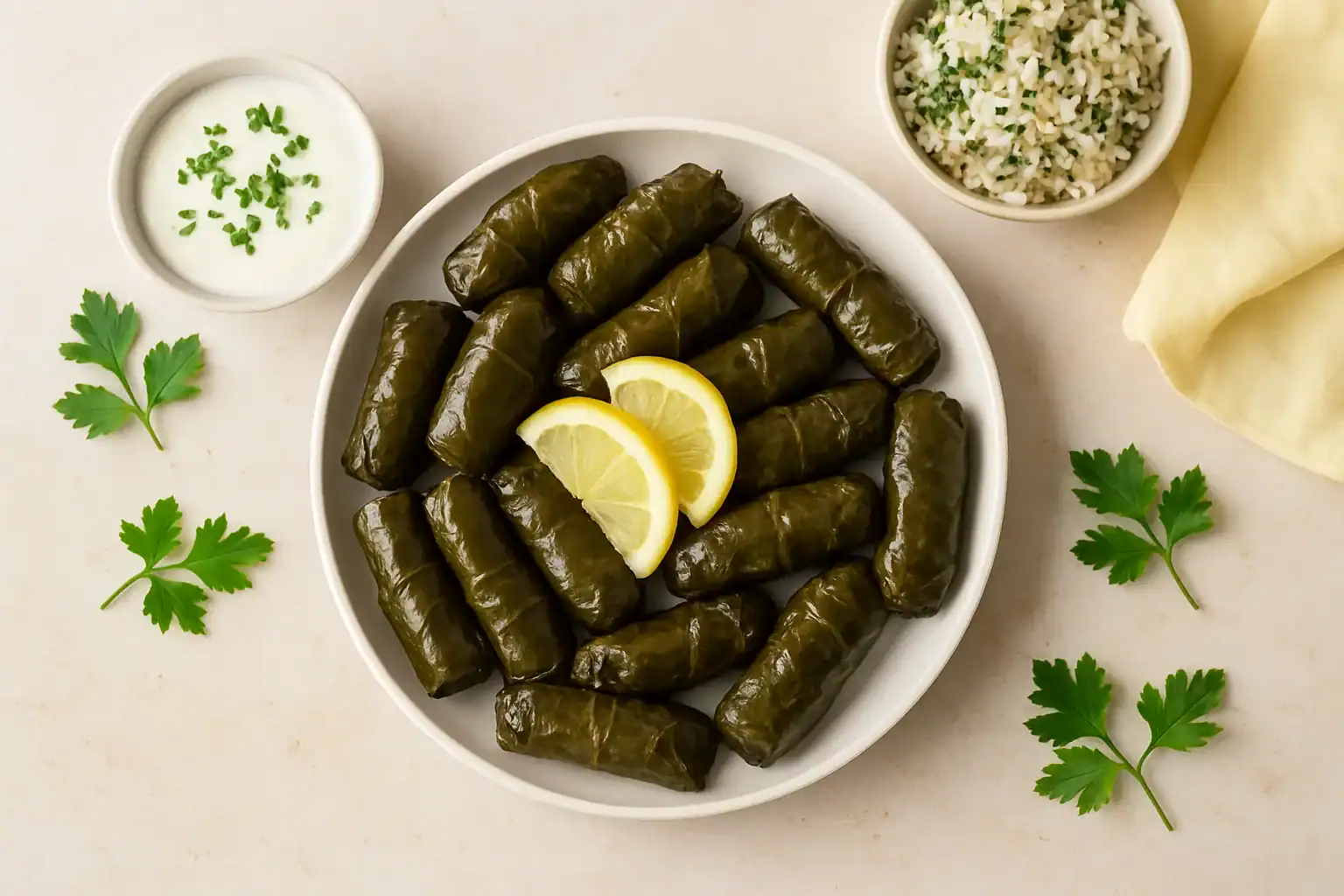
Mediterranean stuffed grape leaves look more difficult than they really are.
The first few rolls may be slightly uneven. That does not matter. By the fifth or sixth leaf, your hands usually understand the movement: filling near the stem, bottom over, sides in, then roll.
For this version, I use grape leaves packed in brine rather than fresh leaves. That removes the blanching step and makes the recipe much more realistic for an ordinary home kitchen.
The filling is simple: rice, onion, parsley, dill, mint, lemon and olive oil. There is no meat, and I do not overload the rice with spices. The grape leaves already bring their own tangy, slightly salty character, so the filling should stay fresh rather than heavy.
The most important things are not overfilling the leaves, not rolling them too tightly and cooking them gently.
Mediterranean Stuffed Grape Leaves: The Quick Answer
If this is your first time making dolmas, remember these five things:
- rinse jarred grape leaves well before using them;
- partially cook the rice before rolling;
- use less filling than you think you need;
- roll snugly but leave the rice a little room to expand;
- keep the rolls packed closely together while they simmer.
The result should be tender but intact, with distinct rice inside and enough lemon and herbs to keep every bite fresh.
What Kind of Grape Leaves Should You Use?
This post contains affiliate links. As an Amazon Associate I earn from qualifying purchases.
For the simplest version, I use grape leaves packed in brine. If they are difficult to find locally, you can also buy jarred grape leaves online.
They are already tender enough to work with and available year-round in many Mediterranean, Middle Eastern and international grocery sections.
Drain them and rinse them well under cool water.
Taste a small edge of one leaf. If it is still aggressively salty or sour from the brine, soak the leaves in cool water for about 10 minutes, then drain again.
Do not worry if some leaves are torn.
Keep those aside. They are useful for lining the bottom of the pot, where they help protect the finished rolls from direct heat.
The Filling Should Be Fresh, Not Heavy
I like a rice filling where you can still identify the herbs.
Parsley gives the base freshness. Dill adds a distinctive green flavor. Mint lifts everything without turning the filling sweet.
Lemon zest works particularly well because it gives aroma without adding too much liquid.
I also use onion, but I soften it first rather than adding it raw. That gives the filling a gentler flavor and makes the final texture more cohesive.
The rice is only partially cooked before rolling.
This matters because it will continue cooking inside the grape leaves, where it absorbs the lemony cooking liquid and some of the flavor from the leaves themselves.
Why I Would Not Use Fully Cooked Rice
Fully cooked rice makes the recipe look faster on paper, but it creates another problem.
The filled leaves still need time in the pot so the grape leaves soften, the flavors come together and the rolls settle.
If the rice is already completely cooked before that stage, it can become too soft.
I prefer to start the rice in the pan for only a few minutes.
It should still be firm when you begin rolling.
That gives it enough structure to finish cooking inside the dolmas rather than simply reheating there.
How Much Filling Goes in Each Grape Leaf?
Less than you expect.
For a medium grape leaf, about two teaspoons is usually enough.
Very small leaves may need only one teaspoon. A large leaf can take a little more.
The exact amount is less important than leaving room for the rice to expand.
If filling pushes out of the sides while you roll, you have probably used too much.
Remove a little and try again.
A slightly small dolma is much easier to cook well than an overfilled one.
How to Roll Dolmas Without Them Falling Apart
Lay the grape leaf flat with the smooth side facing down and the more visible veins facing you.
Keep the stem end closest to you.
Put the filling just above that lower edge.
Fold the bottom of the leaf over the filling.
Bring both sides inward.
Then roll away from you.
The roll should feel secure, but not compressed.
Think of wrapping the filling rather than squeezing it.
If the leaf is unusually large, you can trim a little from the sides. If it is very small, use less filling rather than trying to force the same amount into every leaf.
Pack the Pot Tightly Enough to Hold the Rolls in Place
The pot matters almost as much as the rolling.
Line the bottom with a few torn or unattractive grape leaves.
Then place the dolmas seam-side down, close together.
I usually work around the pot in a circle.
You can add a second layer if necessary.
The rolls do not need to be crushed together, but large empty spaces allow them to move as the liquid simmers.
A small heatproof plate placed upside down over the top helps keep everything in position.
Mediterranean Stuffed Grape Leaves Recipe
Prep time: 30 minutes
Cook time: 40 minutes
Rest time: 20 minutes
Total time: about 1 hour 30 minutes
Servings: 6
Yield: about 24–28 stuffed grape leaves
Calories: approximately 240 per serving, without yogurt
Ingredients
- 30–35 grape leaves packed in brine, plus a few extra or torn leaves for lining the pot
- 1 cup short-grain white rice, rinsed and drained
- 1 small yellow onion, finely chopped
- 5 tablespoons extra-virgin olive oil, divided
- 2 tablespoons finely chopped fresh parsley
- 2 tablespoons finely chopped fresh dill
- 1 tablespoon finely chopped fresh mint
- zest of 1 lemon
- 2 tablespoons fresh lemon juice, plus lemon wedges for serving
- 1 teaspoon salt, or less if the grape leaves are quite salty
- 1/2 teaspoon black pepper
- 1 3/4 cups hot water or light vegetable broth, divided
- Greek yogurt or tzatziki, optional, for serving
Instructions
- Prepare the grape leaves. Drain the leaves and rinse them thoroughly under cool water. If they still taste very salty or strongly brined, soak them in cool water for 10 minutes, then drain. Set aside any torn leaves for lining the pot.
- Start the filling. Heat 2 tablespoons of olive oil in a skillet over medium-low heat. Add the onion and cook for about 4–5 minutes, until soft but not browned.
- Partially cook the rice. Add the rinsed rice and stir for about 1 minute. Pour in 1/2 cup of the hot water or broth and cook gently for about 5 minutes, stirring once or twice, until most of the liquid has been absorbed. The rice should still be firm.
- Add the herbs. Remove the pan from the heat. Stir in the parsley, dill, mint, lemon zest, 1 tablespoon lemon juice, salt and black pepper. Let the mixture cool enough to handle.
- Prepare the pot. Cover the bottom of a wide saucepan with torn or extra grape leaves.
- Fill each leaf. Lay one grape leaf vein-side up with the stem end toward you. Place about 1–2 teaspoons of filling near the base, depending on the size of the leaf.
- Roll. Fold the bottom edge over the filling, fold the two sides inward, then roll toward the tip of the leaf. Keep it snug but not tight enough to prevent the rice from expanding.
- Arrange the dolmas. Place each roll seam-side down in the prepared pot. Pack them closely together in a circular pattern. Add a second layer if necessary.
- Add the cooking liquid. Pour the remaining 1 1/4 cups hot water or broth over the dolmas. Add the remaining 1 tablespoon lemon juice and drizzle the remaining 3 tablespoons olive oil over the top.
- Keep them in place. Put a small heatproof plate upside down over the rolls. Bring the liquid just to a gentle simmer, cover the pot and reduce the heat to low.
- Cook gently. Simmer for about 35–40 minutes. Check one dolma near the end: the grape leaf should be tender and the rice fully cooked. If necessary, add a small splash of hot water and continue cooking for another few minutes.
- Rest before serving. Remove the pot from the heat and leave the dolmas covered for about 20 minutes before moving them. This makes them easier to lift without tearing.
- Serve. Serve warm, at room temperature or chilled, with lemon wedges and Greek yogurt or tzatziki if you like.
Do Not Roll Them Too Tightly
This is probably the mistake I would warn a first-time cook about most.
The instinct is to make every roll neat and firm.
But rice expands.
If the grape leaf is wrapped extremely tightly around an already full center, the roll has nowhere to go as the rice finishes cooking.
That can split the leaf or create a dense filling.
A secure roll with a little internal room is better than a perfect-looking one.
How Do You Know Stuffed Grape Leaves Are Done?
Do not judge them only by the outside.
Take one roll from near the edge of the pot and taste it.
The leaf should be tender enough to cut easily with a fork or bite through cleanly.
The rice should be cooked through but still have individual grains rather than becoming a paste.
The filling should taste lemony and herb-forward, with the slight tang of the grape leaf around it.
If the rice is still firm in the center, add a little hot water and give the pot another 5–10 minutes over low heat.
Let Them Rest Before You Move Them
Freshly cooked dolmas are softer and easier to tear.
I would not begin transferring them to a serving plate as soon as the heat goes off.
Give them about 20 minutes.
The rice settles, the remaining cooking liquid is absorbed and the rolls become easier to handle.
This is also why stuffed grape leaves work so well for a mezze table. They do not depend on arriving piping hot.
Warm, Room Temperature or Cold?
All three can work.
I like this meatless rice-and-herb version best at room temperature or slightly chilled.
The lemon becomes clearer after the rolls rest, and the olive oil gives the leaves a softer texture.
If they have been refrigerated, I would take them out for a little while before serving rather than putting them on the table ice-cold.
What to Serve With Mediterranean Stuffed Grape Leaves
Dolmas already contain rice, so I would keep the rest of the plate relatively simple.
Greek yogurt or tzatziki gives them something cool and creamy.
A tomato and cucumber salad works well if you want something fresh.
For a larger mezze table, our roasted carrot hummus adds something creamy without repeating the same lemon-and-herb profile.
You could also add our Mediterranean roasted red pepper feta dip if you want a saltier, richer element beside the grape leaves.
And for something crisp and acidic rather than another dip, the Sicilian citrus and fennel salad gives the table a completely different texture.
Can You Make Dolmas Ahead?
Yes — and this is one of the reasons I like them.
You can make the stuffed grape leaves a day ahead and refrigerate them once completely cool.
The flavor often becomes more settled after several hours.
Store them in a covered container with a little of their cooking liquid or olive oil so the leaves do not dry out.
I would eat them within about three to four days.
Can You Freeze Stuffed Grape Leaves?
You can, although I prefer the texture from the refrigerator.
If freezing, cool the dolmas completely first and arrange them in a container in layers separated by parchment if necessary.
Thaw them overnight in the refrigerator.
The leaves may become slightly softer after freezing, but the flavor holds up well.
If Your First Batch Looks Uneven, Keep Going
Homemade stuffed grape leaves do not need to look factory-made.
Some leaves are large. Some are small. Some have awkward shapes or a small tear near the edge.
That is normal.
The first roll may be fat.
The third may be too long.
By the time the pot is full, they usually become much more consistent.
What matters more is that the filling stays inside and the rolls are packed securely enough to cook without opening.
Final Takeaway
Mediterranean stuffed grape leaves are not difficult because the technique is complicated.
They simply ask for a little repetition.
Rinse the leaves well.
Keep the filling fresh and only partially cook the rice.
Use a small amount in each leaf.
Roll snugly rather than tightly.
Pack the pot closely and let the dolmas simmer gently.
Once you have rolled a few, the process stops feeling delicate and starts feeling surprisingly straightforward.
And that is the version I would actually make again.