
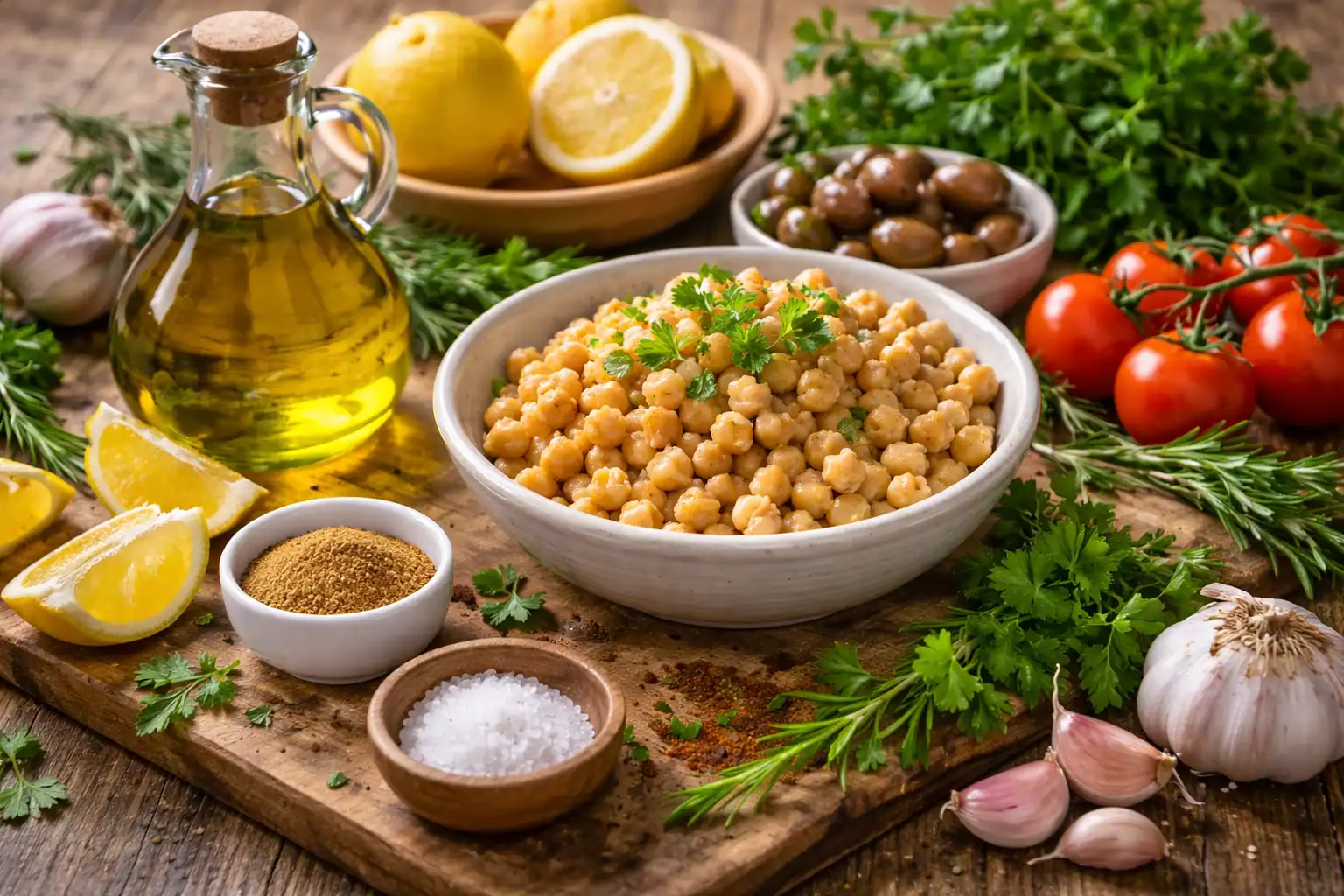
Pantry-first cooking starts with a different question from most recipes: not “What should I make tonight?” but “What do I already have that can become dinner?”
A jar or can of chickpeas and a bottle of olive oil are a good place to begin. On their own, they are basic ingredients. Add something bright, something fresh or cooked, and perhaps bread, grains, cheese or herbs, and they can move in several directions without requiring another complicated shopping list.
That is the useful part of pantry-first cooking. It is not about making the smallest meal possible. It is about knowing how to build a satisfying one from a few dependable ingredients.
What pantry-first cooking actually means
Pantry-first cooking does not mean eating only canned food or avoiding fresh ingredients. It simply changes the order in which you make the decision.
Instead of choosing a recipe first and then buying everything it requires, you begin with what is already available. Maybe there are chickpeas in the cupboard, half a lemon in the refrigerator, parsley that needs using, and a few tomatoes on the counter. That is already enough information to start.
The approach works particularly well on ordinary weekdays because it removes one decision from the evening. You are not trying to invent the perfect dinner. You are looking at a few ingredients and asking what they need in order to feel complete.
If you want to build a broader group of staples around this habit, our Mediterranean capsule pantry covers the ingredients worth keeping around. Here, the focus is narrower: what to do once chickpeas and olive oil are already in front of you.
Start with the chickpeas, then decide: warm or cold?
For me, this is the easiest decision to make first, because it immediately gives the meal a direction without turning it into a recipe.
If the day is warm or you want lunch quickly, drained chickpeas can go straight into a bowl with olive oil and a few fresh ingredients. Tomatoes, cucumber, herbs, onion, roasted peppers, olives or lemon can all change the character of the bowl without turning it into a major cooking project.
If you want something warmer, heat the chickpeas gently in a pan with olive oil, garlic or spices. From there, you can add greens, tomatoes or leftover vegetables, or simply spoon them over toast and finish with lemon.
You do not need to decide on a named dish before you begin. Deciding between warm and cold already eliminates half the possibilities and makes the next step easier.
Olive oil needs something to work with
Olive oil brings richness and carries other flavors, but simply pouring more of it over chickpeas will not necessarily make them taste better.
Usually the bowl needs contrast.
- Acidity: lemon juice, vinegar or a few pickled vegetables.
- Freshness: parsley, mint, dill, cucumber, tomatoes or greens.
- Salt and depth: olives, feta, capers, garlic or spices.
- Texture: toasted bread, seeds, chopped nuts, crisp vegetables or roasted chickpeas.
You rarely need all four. Two good contrasts are often more useful than six additions competing with each other.
That is also why chickpeas and olive oil are such practical pantry partners: neither ingredient dictates the final direction of the meal.
A simple four-part formula for an everyday meal
When you do not want to follow a recipe, use this as a loose formula:
- Start with chickpeas. Drain and rinse canned or jarred chickpeas, or use chickpeas you have already cooked.
- Add one vegetable or green. Use what genuinely needs eating: tomatoes, cucumber, spinach, peppers, zucchini, leafy greens or leftover roasted vegetables.
- Add brightness. Lemon is the obvious choice, but vinegar, capers, pickles or fresh herbs can do the same job.
- Finish according to appetite. Olive oil may be enough for a light bowl. Bread, grains, eggs, tuna or cheese can turn it into a more substantial meal.
The quantities do not have to be exact because this is a framework rather than a recipe. Taste as you go. If the bowl feels dull, it probably needs acidity, salt or herbs before it needs another major ingredient.
Three directions from the same starting point
The same chickpeas and olive oil can become very different meals depending on what the day calls for.
A fresh bowl
Combine chickpeas with tomatoes or cucumber, herbs, lemon and olive oil. Add olives or feta if you want more salt and richness. Keep bread nearby and lunch is finished.
When you want exact quantities rather than improvisation, our Tomato & Caper Chickpea Salad turns this direction into a complete recipe.
A warm skillet
Warm olive oil with garlic, add chickpeas and then whatever vegetable makes sense — spinach, tomatoes, peppers or leftover roasted vegetables all work differently. Finish with lemon rather than continuing to add ingredients until the pan becomes crowded.
A simple bowl that feels like dinner
Start with warm chickpeas and add something that gives the meal more structure: couscous, rice, toasted bread or potatoes. A spoonful of yogurt, a little feta, greens or herbs can finish it without needing a separate sauce.
For a colder evening when you want something more substantial, the one-pot Mediterranean chickpea stew with spinach takes the same pantry logic into a proper warm dinner.
Use fresh ingredients as accents, not another shopping list
One of the easiest ways to lose the benefit of pantry-first cooking is to turn a simple idea into a new recipe that requires seven things you do not have.
If there are tomatoes in the kitchen, use tomatoes. If there is spinach, use spinach. If the only fresh ingredient is a lemon, chickpeas with olive oil, lemon, garlic, salt and warm bread can still be a perfectly reasonable meal.
The goal is not to reproduce an imaginary Mediterranean table every evening. It is to make the food you already have taste intentional.
Know when the meal needs something more
Simple does not have to mean too light.
If chickpeas, vegetables and olive oil leave you hungry an hour later, the answer is not necessarily to make the bowl larger. Think about what is missing.
Bread, potatoes, rice or another grain can give the meal more staying power. Eggs, tuna, yogurt or cheese can change both flavor and substance. Sometimes a bowl needs warmth. Sometimes it needs crunch. Sometimes it simply needs enough salt and lemon to stop tasting unfinished.
Learning to notice that difference is more useful than memorizing another recipe.
Keep the method flexible enough to repeat
A pantry meal becomes genuinely useful when you can make it again without needing the exact same ingredients.
One week it might be chickpeas, tomatoes, parsley, lemon and olive oil. Another week the tomatoes are gone, so you use roasted peppers and a few olives. In colder weather, the chickpeas may end up warm with spinach and garlic instead.
The ingredients change, but the decision-making stays familiar. That is what makes pantry-first cooking easier over time: you are not starting from zero every night.
For nutritional information about individual ingredients such as chickpeas and olive oil, USDA FoodData Central provides a searchable database of foods and nutrient data.
A simple meal does not need to feel improvised
There is a difference between throwing together whatever is left in the kitchen and knowing how a few ingredients can support each other.
Chickpeas give the meal a base. Olive oil carries flavor. Something fresh or cooked changes the texture. Lemon, vinegar, herbs or another sharp ingredient keeps the bowl awake. From there, you add only what the meal actually needs.
That is the real advantage of pantry-first cooking. It makes an ordinary cupboard useful on an ordinary day — without asking every dinner to begin with a new plan.