
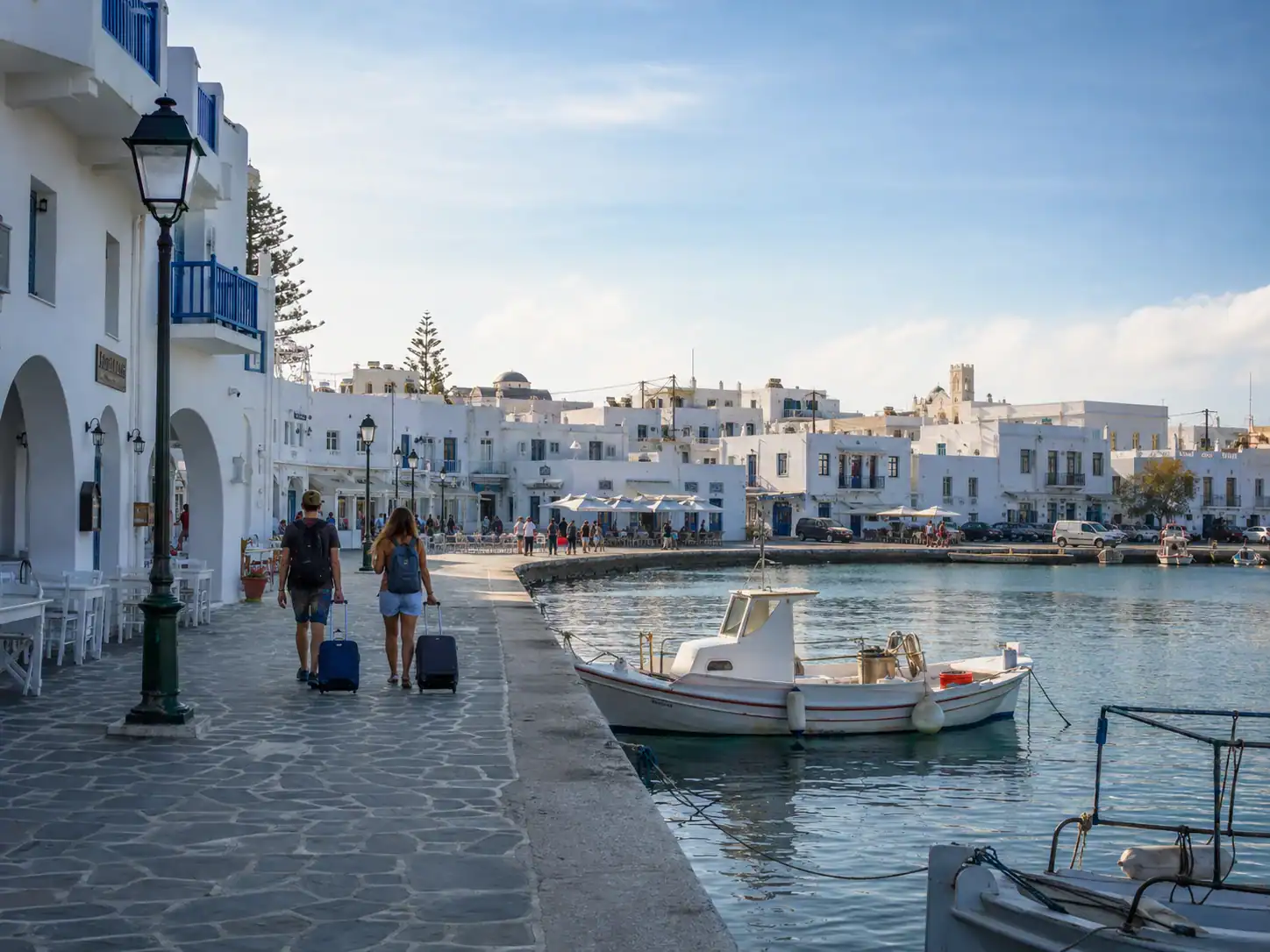
Paros and Naxos are often compared as if the decision were only about beaches, food or which island is prettier. Without a car, the more useful question is different: which island makes the actual holiday easier?
That changes everything. A beautiful beach matters less if it takes too much effort to reach every day. A charming village matters less if evenings depend on long taxi rides or complicated bus timing. When you are traveling without a car, ease becomes part of the destination itself.
This article contains affiliate booking links. If you book through them, we may earn a small commission at no extra cost to you.
The short answer is this: Paros is usually the easier all-round island without a car, while Naxos can be more rewarding if you are happy to build the trip around Chora and the west-coast beach corridor rather than expecting total freedom across the whole island.
What “without a car” really changes
Without a rental car, you are not choosing only an island. You are choosing a base, a beach rhythm, an evening rhythm and how much friction you are willing to accept between them.
Some islands still work naturally because the main town, beaches, buses and restaurants connect into an easy pattern. Others remain possible, but the trip starts depending on more planning. The difference is not whether the island is “good” or “bad” without a car. It is whether the best parts of the island still remain easy enough to use.
If you are already thinking in this more practical way, our Sifnos without a car guide takes a similar approach with a smaller Cycladic island.
Quick answer: which island is easier?
Choose Paros if you want the smoother overall holiday: easier movement between lively bases, beaches that feel more naturally tied into the bus network, and a trip where you spend less energy solving transport every day.
Choose Naxos if you want a larger-feeling island, stronger beach variety along the west coast, and a trip that can still work beautifully without a car as long as you accept one important limitation: not every interesting part of Naxos will feel equally easy from the same base.
For me, that is the real dividing line. Paros removes more small decisions. Naxos gives more range, but only if you are comfortable with a little more structure.
Why Paros is usually easier without a car
Paros is one of the simplest Greek-island choices when you want your days to stay flexible without becoming transport-heavy. The island is compact enough that moving between town life, beaches and dinner rarely feels like a major undertaking.
Parikia helps a lot here. It is the ferry arrival point, the main transport hub and a walkable base with restaurants, waterfront evenings and enough everyday usefulness that you do not feel stranded between outings. If you stay there, the island begins to make sense quickly.
Naousa can also work without a car, especially if atmosphere matters more than pure convenience. It is more polished, more expensive and often more sought-after, but it is not quite as frictionless as Parikia when ferry arrival, luggage and bus movement are part of the equation.
The larger point is that Paros tends to feel coherent without a car. Beaches, bases and evenings connect more easily into the same trip rather than feeling like separate logistical problems.
Why Naxos can still be the better choice
Naxos is larger, broader and in some ways more generous than Paros. That is exactly why some travelers end up preferring it. You get a stronger sense of an island with several moods rather than one polished rhythm.
But this is also where the without-a-car question becomes more important.
Naxos works best without a car when you stay in Chora or along the Agios Prokopios–Agia Anna beach corridor. That west-coast sequence is practical, attractive and easy enough to reuse for several days. If the holiday is built around beaches, simple meals, evening walks and a base that does not require constant decisions, Naxos can feel excellent.
The limitation comes when you want the island to open fully. Mountain villages, more remote beaches and the feeling of freely crossing different sides of Naxos become harder without a car. That does not ruin the trip. It simply means you should not choose Naxos expecting the whole island to feel equally available every day.
If you want the seasonal version of this logic, our Naxos in May guide explains why the west coast and village evenings become such an important part of the island’s rhythm.
Best base in Paros without a car
Parikia is the easiest base overall. It gives you the easiest arrival, the strongest bus convenience and a very usable day-to-evening rhythm. You can arrive by ferry, settle in without needing a transfer plan, walk for dinner and use buses on the following days without building the whole holiday around them.
Naousa is the better choice only if the atmosphere is the priority. It is very appealing, especially in the evening, but it is a slightly less practical answer to a slightly more romantic question.
If you want the simplest version of Paros without a car, I would start with Parikia first and only move to Naousa if you know that style of base matters more to you than maximum convenience.
You can browse places to stay in Paros if you want to compare Parikia and Naousa more closely before booking.
Best base in Naxos without a car
Chora is the easiest all-round base. It gives you the widest mix of restaurants, evening life, ferry practicality and bus usefulness. If you are not fully sure how beach-led the trip will be, Chora is the safest answer.
Agios Prokopios or Agia Anna are better if the beach is central to the trip. You wake near the sea, repeat swimming more easily and still remain close enough to Chora for evenings when you want more movement.
This is where Naxos becomes a very personal choice. If I wanted a little more variety every day, I would choose Chora. If I wanted the beach to shape the trip from morning onward, I would lean toward Agios Prokopios.
You can browse places to stay in Naxos if you want to compare Chora with the west-coast beach bases.
Which island is better for beaches without a car?
If easy beach access is the only question, both islands can work, but in different ways.
Paros gives you an easier overall island structure. You are less likely to feel that the best version of the island lives somewhere you cannot comfortably reach.
Naxos gives you a stronger beach corridor if you stay in the right place. Agios Prokopios, Agia Anna and Plaka can support several very satisfying beach days without making the trip feel repetitive too quickly.
So the better answer depends on what kind of beach trip you want. Paros is easier in the general sense. Naxos is stronger if your trip can genuinely revolve around those west-coast beaches.
Which island feels better in the evening?
Evenings matter more than people admit when choosing an island without a car.
Paros tends to feel more naturally “finished” at the end of the day. Whether you are based in Parikia or Naousa, it is easier to step into a clear evening center without the day having asked too much from you.
Naxos also has strong evenings, especially in Chora, but the balance depends more on where you stay. A beach base can be wonderful, though it may create a slightly split rhythm: beach ease by day, town atmosphere only when you choose to go in.
If you care about easy evenings as much as beaches, Paros usually has the edge.
What I would choose for 5 days
For a five-day trip without a car, I would choose Paros if I wanted the smoother holiday.
That is not because Naxos is worse. It is because a shorter trip benefits more from ease than from range. The fewer days you have, the more useful it is when ferry arrival, buses, beaches and dinner all connect naturally from the same base.
Naxos can still work very well in five days, but I would choose it only if I already knew the trip would be built around Chora or the west-coast beach zone rather than around “seeing the whole island.”
What I would choose for 7 days
For a full week, the decision becomes closer.
If you want one island to feel easy and readable from the beginning, Paros still wins. If you want a week that feels broader, a little more varied and slightly less polished, Naxos becomes more tempting.
With seven days, I would choose Naxos if I were happy with a beach-and-town rhythm plus one or two more deliberate outings. I would choose Paros if I wanted the week to stay lighter and simpler from start to finish.
That is why this comparison does not have one universal winner. The better island is the one whose limitations you mind less.
Should you split both islands in one week?
Usually, no.
It is possible, and some travelers enjoy the variety, but one week without a car already depends on ferry timing, accommodation changes and reorientation in each new base. Unless you actively enjoy moving around, splitting Paros and Naxos in the same short trip often reduces the very ease you were hoping to preserve.
If you have seven days and want a calm trip, I would choose one island and let the base start working for you. Save the second island for another visit rather than forcing a comparison in real time.
For current ferry timing and island connections, Ferryhopper is a useful practical reference before you book dates too tightly.
Final answer: Paros or Naxos without a car?
Choose Paros without a car if you want the easier all-round holiday. It is the island I would trust more for a first car-free Cyclades trip built around simple movement, beaches, town life and evenings that happen without much effort.
Choose Naxos without a car if you want the more varied island and are happy to build the trip around the parts that work best on foot and by bus. It asks slightly more from you, but it can give more back if that trade-off suits your style of travel.
So the real question is not which island is objectively better. It is which one makes the kind of trip you actually want feel easier every day. Without a car, that is usually the answer that matters most.
If you are still choosing more broadly, our Greek Islands Without a Car guide compares Paros and Naxos with Sifnos, Syros, Hydra and Corfu for 4–7 day trips.