
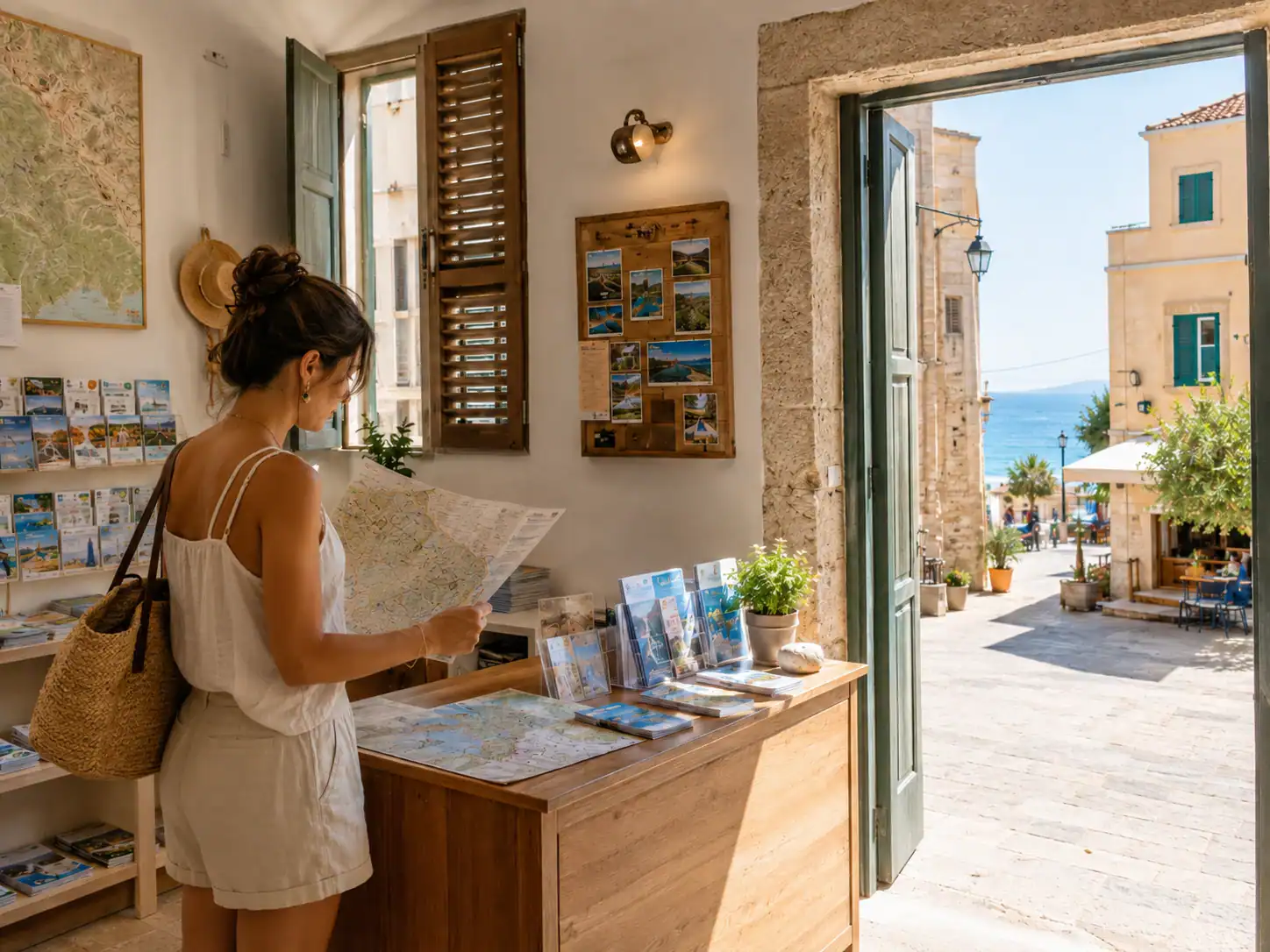
A Mediterranean town can look simple when you first arrive. The sea is in one direction, the old streets are in another, and the first idea is usually to start walking. Sometimes that works beautifully. Other times, ten minutes at the tourist office can make the whole first walk easier.
The best questions are the small ones you ask before the day gets hot or confusing.
A tourist office is not only for brochures or guided tours. In a small coastal town, island port, old center or beach city, it can help you understand the practical side of the place before you spend an hour guessing.
Ask for the simplest walking map
Do not ask for the most beautiful map. Ask for the simplest one.
A good first map shows the old center, the waterfront, the station or port, the main square, the market area, the beach access points and the streets that connect them. It does not need to show every monument. It needs to help you walk without turning every corner into a small decision.
Digital maps are useful, but a paper map can show the town as a whole. It helps you see whether the harbor is close to the old town, whether the beach is farther than it looked online, and whether your first walk should be a loop or a straight line.
Ask which route is easiest, not only shortest
In many Mediterranean towns, the shortest route is not always the easiest one. A map may show a five-minute walk, but not the steps, slope, uneven stone, exposed sun or narrow pavements.
This is where a local answer helps. Ask which way is easier on foot. Ask if there is a flatter route to the old town, a shaded street toward the harbor, or a better way back from the beach in the afternoon.
This connects naturally with Mediterranean summer walking tips, because walking here is not only about distance. Shade, water, benches and timing can change how the same street feels.
Ask about local buses before you need one
A local bus can turn a Mediterranean stay from tiring to simple. It can connect the station to the old town, the port to the beach, or the center to a nearby village. But the useful detail is often not obvious from the bus stop itself.
Ask where the nearest bus stop is, where tickets are bought, and whether the last return is early. Do not ask for a perfect day plan. Ask for the one or two useful routes that visitors actually use.
The bigger logic is the same as in Mediterranean local bus tips: the bus ride may be short, but the stop, shade, ticket and timing shape the experience.
Ask where public toilets are before it becomes urgent
This is not the glamorous part of travel, but it matters. A first walk can become awkward quickly if the old town is hilly, the cafés are crowded, the beach is farther away, or the station is behind you.
Ask if there are public toilets near the main square, market, beach, port, bus terminal or museum area. Ask if they are free, paid, seasonal or inside a public building.
You do not need to turn the day into a checklist. You only need one or two useful points in your head. Our guide to public toilets in Mediterranean travel goes deeper into where to look before you need one.
Find out where water is easy to get
Public drinking fountains are not everywhere, and their visibility changes from town to town. Some places have clear fountains near squares, promenades or older walls. Others rely more on cafés, shops or beach bars.
Ask if there are public drinking fountains in the center or near the beach. If not, ask where it is easiest to buy water before walking uphill, waiting for a bus, or spending time in the old town.
This is especially useful on arrival day. You may not know yet which streets are shaded, which shops close early, or how far the room really is from the center.
Ask about market days and closing times
A Mediterranean market can change the rhythm of a morning. Streets become busier, shops open earlier, cafés fill, and the best food is often gone before late morning. But markets do not always run every day.
Ask which days the market is open, when it is busiest, and whether it is food-focused, tourist-focused or a mix of both. Ask the same about afternoon closures, Sunday hours and public holidays if your stay is short.
This is useful even if you are not planning a big food morning. A market can affect walking routes, parking, bus stops, toilets, crowds and where to buy a simple lunch.
Ask about small closures, works and events
Online maps rarely tell you everything that matters today. A street may be blocked for repairs. A museum may close early. A waterfront may be busy because of an event. A ferry area may have temporary changes. A staircase may be closed. A local festival may make the town better in one direction and harder in another.
A tourist office often knows these small things. Ask if there is anything happening today that changes the way you should walk.
This question can save more time than asking for the “best things to see.” The famous places are easy to find. The small disruptions are what catch you when you are tired.
Look for one good place to pause
A first walk does not need to be packed. It works better when you know where to pause.
Ask where there is a shaded square, an easy bench, a calm waterfront stretch, a public garden, a covered market edge, or a quiet café area that is not directly in the busiest lane.
This keeps the day human. You are not trying to conquer the town. You are trying to understand how it works on foot.
Ask what is local, but do not ask for a performance
There is a useful way to ask for local advice. Keep it simple.
Ask where people walk in the early evening. Ask where the market feels normal rather than staged. Ask which street is good for a slow first look. Ask where to avoid walking in the strongest sun.
Do not ask the person at the desk to solve the whole trip. A small, practical question often gets a better answer than a broad one like “What should I do here?”
For a wider example of how official visitor information is organized, the official tourism information for Spain shows how transport, brochures, routes and practical destination details are usually gathered in one place before a trip.
Take the map, then leave room for the town
The tourist office should not make the day rigid. It should make the first walk easier.
Take the map. Mark the useful places. Notice the bus stop. Remember one public toilet. Find the nearest water point. Check if the market is tomorrow. Ask which route is easier in the heat.
Then walk.
A Mediterranean town usually reveals itself slowly. The useful details do not remove the pleasure. They give it more space. When you know where to find water, shade, toilets, transport and a simple way back, the first walk feels less like guessing and more like arriving.