
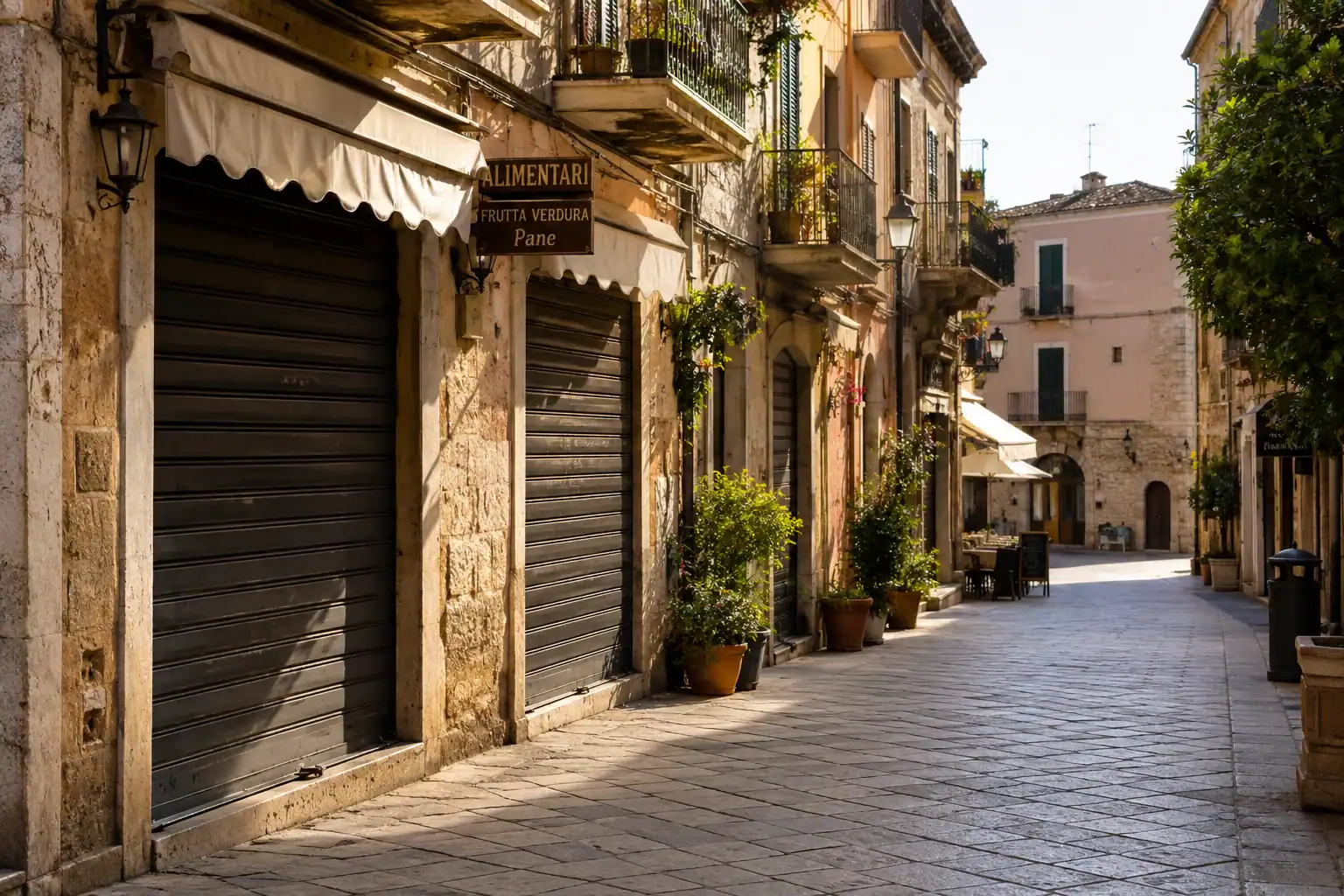
Shops close in a Mediterranean town at exactly the moment you remember you still need water, breakfast, sunscreen, a phone charger or something simple for dinner. It is not a disaster. It is just one of those travel details that becomes much easier once you stop assuming the day will work like it does at home.
Closed shutters are not always a problem
In many Mediterranean towns, the middle of the day can feel strangely unfinished. A bakery that was busy in the morning has its shutters down. A small grocery shop has a handwritten sign on the door. A street that looked useful at 10 a.m. looks sleepy after lunch. You may still find cafés open, restaurants preparing for later, beach kiosks doing business and tourist-zone shops running longer hours, but the ordinary local errands can become less predictable.
That is why the smartest plan is not to panic when shops close. It is to understand which errands should be done early, which ones can wait, and which ones do not need to control the day.
The first thing to remember is that Mediterranean towns are not all the same. A busy resort street in July, a small inland town on a Sunday, an island port in shoulder season and a city neighborhood in August can all behave differently. Opening hours can change by country, region, season, holiday and even by street.
So the useful habit is simple: when you arrive, notice the rhythm before you need it.
Look at the shop signs while you are already walking. Check whether the bakery opens early. Notice if the pharmacy has a break in the middle of the day. See whether the small grocery stays open into the evening or closes after lunch. These details seem boring until they save the next morning.
A good first rule is to do the small essentials before the day gets too hot or too quiet. Water, fruit, bread, yogurt, coffee, milk, something salty, and a few easy things for breakfast are better bought when the town is awake. You do not need a full grocery plan. You just need enough to avoid starting the next day hungry and annoyed.
That is especially true after arrival. The first evening is not the best time to solve every local habit, every shop schedule and every kitchen problem. It is enough to make the first night and morning work. If the next day is your first real day in town, the rhythm will be easier to read after sleep, daylight and a short walk. That is why the first full morning in a Mediterranean town often matters more than the exact arrival hour.
Markets are another reason to think early. If a town has a morning market, it may be the easiest place to buy fruit, tomatoes, bread, herbs, cheese or something simple for lunch. But markets are usually not waiting for the traveler who starts slowly at noon. They belong to the earlier part of the day, when locals are already choosing what looks good.
If you want to shop this way, do it before the street becomes too hot or too empty. Walk first, look at what is fresh, then buy only what you can carry and use. Our guide to Mediterranean market mornings looks more closely at that first slow pass through the stalls.
Sunday needs a slightly different plan. In some towns, Sunday still feels active near the waterfront, around cafés or in tourist areas. In others, the ordinary shopping streets are much quieter. A restaurant may be open while the small grocery is closed. A bakery may open early and finish before you think about breakfast. A pharmacy may have a duty schedule instead of normal hours. A supermarket may be open in one area and closed in another.
That is why Sunday is not the day to leave every practical errand until late. Buy the boring things first: water, something for breakfast, something small for the room, and any item you would be irritated not to have. After that, the rest of the day can be slower.
One useful travel habit is to separate “nice to have” from “annoying if missing.” A cold drink from a café is nice. Water in the room is useful. A restaurant dinner is nice. Something simple for breakfast is useful. A pretty market bag is nice. A small pack of tissues, sunscreen or basic toiletries can become useful very quickly if shops close.
I have learned not to treat a closed shop as a failed plan. Often it just means the errand belonged to a different hour.
Afternoon closures are similar. They are not always formal, and they are not the same everywhere. Some shops stay open all day, especially in busy areas. Others close for a long break and reopen later. Some streets seem almost empty for a few hours, then come back to life when the light softens and people return outside.
For a traveler, that middle part of the day is better used for shade, rest, a simple lunch, a museum, a swim, a slow coffee or time back at the apartment. It is not always the best time to chase practical errands through hot streets.
This is where a no-cook lunch can help. If you bought bread, tomatoes, fruit, cheese, olives or something from the market earlier, you are not dependent on finding the right shop open at the right minute. A simple no-cook market lunch can make a quiet afternoon feel easy instead of inconvenient.
Evening reopening can be one of the nicest parts of the day. The same shuttered street may change after six or seven. Lights come on. Shop doors open again. People walk more slowly. Small errands become part of the evening, not a separate task. You may buy water, fruit, a postcard, bread for the morning, or something small for the room while you are already outside.
But do not build the whole day on the hope that everything reopens. Check locally. In some places the evening return is strong. In others, especially on Sunday, outside peak season or in smaller towns, it may be limited.
For practical planning, a small checklist helps:
Buy water before you need it.
Do breakfast shopping before the evening gets uncertain.
Do market shopping in the morning, not after lunch.
Check pharmacy hours before you urgently need one.
Do not assume Sunday works like Saturday.
Notice handwritten signs on small shops.
Keep one simple food option in the room.
Do heavier errands before the hottest part of the day.
Use the quiet hours for rest, shade or a slower lunch.
Check local information when hours really matter, because shopping hours can vary by country and region.
The point is not to turn a Mediterranean town into a schedule. The point is to make the ordinary things easier so the day can stay open.
A closed shop is only a problem when it is the only plan. If you have water, breakfast, one simple food option and a sense of when the street wakes up again, the pause becomes part of the town’s rhythm instead of a travel mistake.